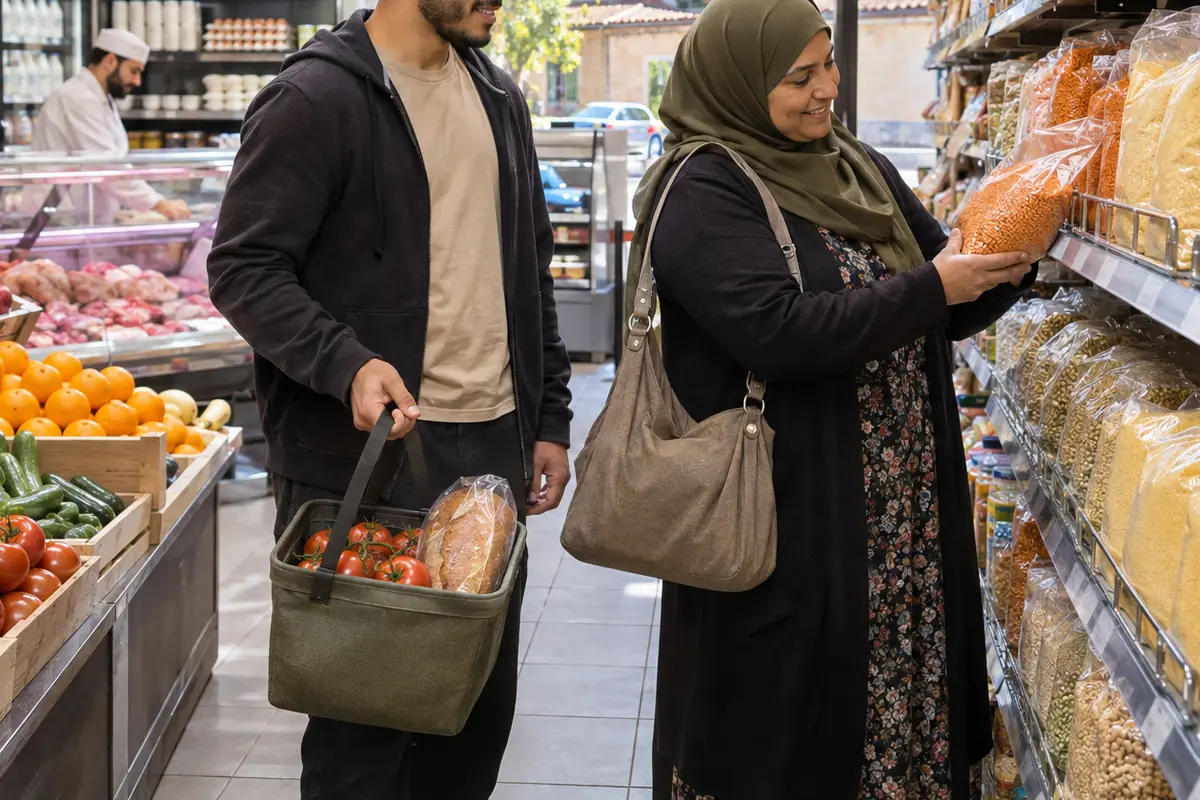
A halal supermarket franchise business lets an independent operator open a food store under an established banner, with a ready-made halal range, supplier network and shop design. In exchange, the franchisee pays an entry fee, ongoing royalties and carries the investment costs of the premises, fixtures and opening stock. Buying an existing halal supermarket is a different route, where the buyer takes over a going concern, its customers and its supplier contracts. Both paths require close attention to certification, sourcing and the real cost structure of discount grocery retail.
Halal supermarket franchise business models compared
Franchise offers in food retail generally fall into a few families. Some banners sell a complete supermarket format with a broad grocery range, while others focus on a halal butcher counter combined with dry goods and frozen lines. A third family covers convenience-sized shops aimed at neighbourhood top-up shopping.
Each model implies a different floor area, staffing level and stock turnover. A candidate should ask which format matches the catchment area, because a large store in a thin residential district tends to struggle, whereas a compact format may leave demand untouched in a dense one.
Brand recognition also differs widely. A well-known banner brings immediate trust and national marketing, whereas a younger concept may offer lower entry conditions and more freedom in the product range. Visiting several outlets of each concept, and watching how shoppers actually behave there, reveals more than any brochure. Speaking to franchisees who left the network can be just as instructive as meeting satisfied ones.
What the purchase of a halal supermarket involves
Taking over an existing store means acquiring the business as a whole: lease or property, equipment, goodwill, customer base and sometimes staff. The seller usually provides accounts, supplier agreements and licence documents, which the buyer should review with an accountant and a lawyer.
An important check concerns the halal credentials already in place. Contracts with slaughterhouses, certification bodies and wholesalers do not always transfer automatically, so the buyer should confirm in writing what continues after the change of ownership.
Valuation deserves caution as well. Asking prices often reflect the owner's expectations rather than actual earnings, so a buyer benefits from examining several years of accounts, stock records and supplier invoices. A handover period, during which the seller introduces regular customers and suppliers, helps preserve the goodwill being paid for.
Investment costs to budget before opening
Investment costs usually break down into several blocks: the franchise or purchase fee, the lease deposit, shop fitting, refrigeration and freezer equipment, point-of-sale systems, signage and the first stock order. Refrigeration deserves special care, since a halal range relies heavily on fresh and frozen meat.
Working capital is the block most often underestimated. Perishable stock, wages and utilities must be covered during the first months, before regular customers appear. A prudent plan keeps a reserve rather than spending everything on the fit-out.
Hidden items regularly appear: licences and inspections, insurance, professional fees, legal drafting of the lease, and repairs to second-hand equipment. Collecting written quotations from several contractors, and asking a franchisor for a detailed list of what the fee covers, limits unpleasant surprises once works begin. Delays in construction or equipment delivery also carry a cost, because rent and loan repayments continue regardless.
Franchise fees, royalties and supply obligations
A franchise agreement typically combines an entry fee with recurring payments, often a royalty on turnover and a contribution to national advertising. The exact structure depends on the banner, so every clause should be read against the sample accounts the franchisor provides.
Supply obligations matter as much as fees. Some networks require purchasing through their central warehouse, which can simplify halal traceability but limits the freedom to negotiate with local producers. Candidates should ask what share of stock may be sourced independently.
Duration and exit terms complete the picture. Length of the contract, renewal conditions, territorial exclusivity and the right to resell the store all shape the long-term value of the investment. A franchisee who cannot sell on without the franchisor's approval holds a weaker asset than one with clear transfer rules. Non-compete clauses after departure should be read just as carefully.
Halal certification and sourcing as a business asset
In this trade, trust is the main commercial asset. Shoppers look at labels, the certifying organisation and the slaughter method stated for meat and poultry. A store that documents its sources clearly builds loyalty faster than one that relies on a general halal claim.
Operators should therefore understand how their supply chain is audited, who issues certificates, and how products without meat, such as confectionery or sauces, are checked for gelatine, alcohol and animal-derived additives.
Clear shelf communication supports the effort. Displaying the certifying body, explaining the origin of meat and training staff to answer ingredient questions politely all reassure families who read every label. Where a banner supplies marketing material on certification, the operator should still verify that it matches the products actually on sale.
Choosing a location and reading local demand
Location decides much of the outcome. Proximity to mosques, community centres, student areas and busy transport routes tends to support footfall, yet competition from mainstream chains that now stock halal ranges must also be assessed carefully.
A site visit at different times of day, conversations with nearby traders and a look at car parking and delivery access give a more reliable picture than general statistics. Cash and carry outlets nearby can also influence pricing pressure.
Lease terms are part of the location decision. Rent review clauses, permitted use, opening hours restrictions and the landlord's attitude towards refrigeration units or extraction systems can all affect running costs. A promising address with an unfavourable lease can quietly erode the profitability of an otherwise sound halal grocery.
Running a discount-oriented halal grocery
Discount grocery works on narrow margins and fast turnover. Buying in volume, limiting waste on fresh produce and keeping a tight product list are the usual levers. Own-label lines, where a banner offers them, can help protect margins without lowering quality.
Staffing must combine customer service with butchery and handling skills where a meat counter exists. Training on hygiene, cold chain and allergen labelling is a legal and reputational necessity, not an optional extra.
Customer habits shape the weekly rhythm. Busy periods often precede religious festivals and weekends, when families buy meat, rice, dates and spices in larger quantities. Planning deliveries, rota and promotions around these peaks avoids both empty shelves and unsold perishable stock, which is the costliest mistake in this segment.
Financing, advice and due diligence
Funding usually combines personal capital with a bank loan, and some operators look for sharia-compliant financing structures. Lenders expect a business plan with cash-flow forecasts, so preparing realistic scenarios, including a slow start, is essential.
Before signing, a candidate should speak with existing franchisees without the franchisor present, compare at least two concepts and obtain independent legal advice. Trade associations for franchising offer codes of conduct and practical guidance for newcomers.
A realistic timeline also helps. Searching, negotiating, financing, fitting out and obtaining approvals rarely run as quickly as brochures suggest, and rent often starts before the first sale. Building a margin for delays, and keeping a clear line of communication with the lender, protects the project during this exposed period.